
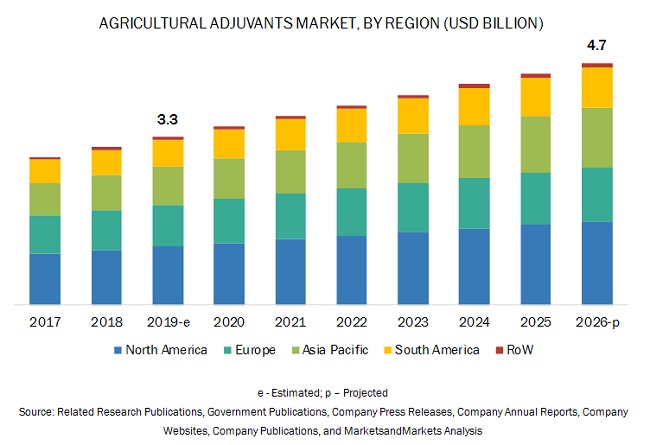
The agricultural adjuvants market is estimated to account for a value of USD 3.3 billion in 2019 and is projected to grow at a CAGR of 5.3% from 2019, to reach a value of USD 4.7 billion by 2026. An increasing need for green adjuvants, improving efficiency and effectiveness of agrochemicals are some of the factors driving the growth of this market.
Surfactants segment by activator adjuvants is expected to be the most widely used function of agricultural adjuvants market.
Surfactants have been mixed traditionally with pesticides, especially herbicides, to enhance the droplet retention characteristics of pesticides. The market for agricultural surfactants accounted for the largest share of the global agricultural adjuvants market. Also, amongst the products offered by the key players, products offered as non-ionic surfactants are of much higher preference for its compatibility with a broader range of pesticides. Due to these factors, the market is projected to witness significant growth.
The herbicides segment is estimated to witness the fastest growth in the agricultural adjuvants market, in terms of value from 2017 to 2026
Herbicides are used to kill or control unwanted plants. They have largely replaced mechanical methods of weed control in countries where intensive and highly mechanized agriculture is practiced. Adjuvants are the substances which are either added in a herbicide formulation or to the spray tank that helps in modifying the herbicidal activity or application characteristics, such as spray retention and droplet drying, increasing droplet coverage, increasing herbicide cuticle penetration, better mixing and handling, as well as cellular accumulation which reduces the leaching of herbicide through the soil profile, etc. The benefits associated with herbicides are the major factors contributing to the fastest growth of this market, globally.
The increasing demand for improved varieties in crops in the Asia Pacific regions is driving the growth of the agricultural adjuvants market.
Asia Pacific comprises of developing countries with vast agricultural lands; the per capita income of the region depends on agricultural activities. Agricultural technologies are widely accepted and practiced in this region. In Asia Pacific, the total area under agriculture is shrinking due to the high rate of industrialization and urbanization. As a result, farmers opt for practices such as the use of chemical pesticides, which help to increase the yield or productivity of crops.
Key Market Players
Key players in this market include Corteva Inc. (US), Evonik Industries (Germany), and Solvay (Belgium). These major players in this market are focusing on increasing their presence through expansions & investments, mergers & acquisitions, partnerships, joint ventures, and agreements. These companies have a strong presence in North America, Asia Pacific, and Europe. They also have manufacturing facilities along with strong distribution networks across these regions.
Key questions addressed by the report:
Report Objectives:
- To define, segment, and project the global market size of the agricultural adjuvants market.
- To understand the agricultural adjuvants market by identifying its various subsegments
- To provide detailed information about the key factors influencing the growth of the market (drivers, restraints, opportunities, and industry-specific challenges)
- To analyze the micromarkets with respect to individual growth trends, future prospects, and their contribution to the total market
- To project the size of the market and its submarkets, in terms of value, with respect to the regions (along with their respective key countries)
- To profile key players and comprehensively analyze their core competencies
- To understand the competitive landscape and identify major growth strategies adopted by players across key regions
- To analyze the competitive developments such as expansions & investments, mergers & acquisitions, new product launches, partnerships, joint ventures, collaborations, divestments, disinvestments, and agreements
Download PDF Brochure: https://www.marketsandmarkets.com/pdfdownloadNew.asp?id=1240
Surfactants segment by activator adjuvants is expected to be the most widely used function of agricultural adjuvants market.
Surfactants have been mixed traditionally with pesticides, especially herbicides, to enhance the droplet retention characteristics of pesticides. The market for agricultural surfactants accounted for the largest share of the global agricultural adjuvants market. Also, amongst the products offered by the key players, products offered as non-ionic surfactants are of much higher preference for its compatibility with a broader range of pesticides. Due to these factors, the market is projected to witness significant growth.
The herbicides segment is estimated to witness the fastest growth in the agricultural adjuvants market, in terms of value from 2017 to 2026
Herbicides are used to kill or control unwanted plants. They have largely replaced mechanical methods of weed control in countries where intensive and highly mechanized agriculture is practiced. Adjuvants are the substances which are either added in a herbicide formulation or to the spray tank that helps in modifying the herbicidal activity or application characteristics, such as spray retention and droplet drying, increasing droplet coverage, increasing herbicide cuticle penetration, better mixing and handling, as well as cellular accumulation which reduces the leaching of herbicide through the soil profile, etc. The benefits associated with herbicides are the major factors contributing to the fastest growth of this market, globally.
The increasing demand for improved varieties in crops in the Asia Pacific regions is driving the growth of the agricultural adjuvants market.
Asia Pacific comprises of developing countries with vast agricultural lands; the per capita income of the region depends on agricultural activities. Agricultural technologies are widely accepted and practiced in this region. In Asia Pacific, the total area under agriculture is shrinking due to the high rate of industrialization and urbanization. As a result, farmers opt for practices such as the use of chemical pesticides, which help to increase the yield or productivity of crops.
Request for Customization: https://www.marketsandmarkets.com/requestCustomizationNew.asp?id=1240
Key Market Players
Key players in this market include Corteva Inc. (US), Evonik Industries (Germany), and Solvay (Belgium). These major players in this market are focusing on increasing their presence through expansions & investments, mergers & acquisitions, partnerships, joint ventures, and agreements. These companies have a strong presence in North America, Asia Pacific, and Europe. They also have manufacturing facilities along with strong distribution networks across these regions.
Key questions addressed by the report:
- What are the new application areas for the agricultural adjuvants market that companies are exploring?
- Who are some of the key players operating in the agricultural adjuvants market and how intense is the competition?
- What kind of competitors and stakeholders would be interested in this market? What will be their go-to-market strategy, and which emerging market will be of significant interest?
- How are the current R&D activities and M&A’s in the agricultural adjuvants market projected to create a disrupting environment in the coming years?
- What will be the level of impact of new product launches on the revenues of stakeholders, due to the benefits offered by agricultural adjuvants market, such as increasing revenue, environmental regulatory compliance, and sustainable profits for the suppliers?
