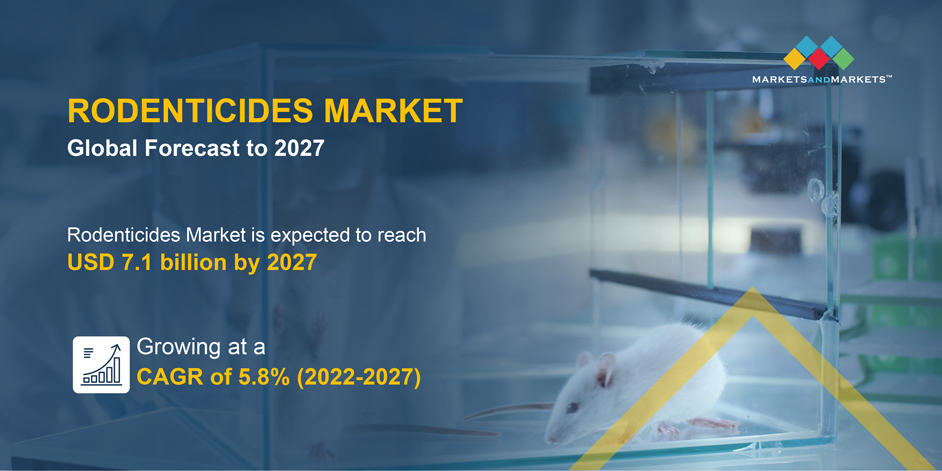
The report "Rodenticides Market by Type (Non-Anticoagulants, Anticoagulants (FGAR, SGAR)), End-Use Sector (Agricultural Fields, Warehouses, Urban Centers (Residential, Commercial)), Mode of Application (Pellets, Sprays, Powders), and Region - Global Forecast to 2025", is projected to reach USD 5.9 billion by 2025, from USD 4.7 billion in 2019, at a CAGR of 3.7% during the forecast period. The market is driven by factors such as urbanization and industrialization, along with public awareness about chemical-based rodenticides.
Increasing residential and commercial settings due to the migration of people from rural areas, resulting in the displacement of rats, is one of the major factors affecting the growth of the rodenticides market during the forecast period.
Rodenticides are used for the purpose of killing and repelling rodents from the areas susceptible to damages caused by rats in commercial settings, residential spaces, agricultural fields, and warehouses. People migrating from rural areas to urban centers triggered the rats to displace from their places, and these rats or rodents found their homes near to humans. This created the need for using rodenticides to get rid of these rodents. Furthermore, the increasing awareness among people and the consciousness towards health and hygiene also encouraged them to make use of the rodenticides.
Download PDF Brochure:
https://www.marketsandmarkets.com/pdfdownloadNew.asp?id=189089498
https://www.marketsandmarkets.com/pdfdownloadNew.asp?id=189089498
By type, the anticoagulants segment dominated the rodenticides market in 2018
Across the majority of the developed nation’s pesticide registry, anticoagulant rodenticides are the most widely approved products in the market. Active ingredients, such as bromadiolone and brodifacoum, have gained increased popularity among pest control operators for urban application. Thus, the anticoagulants segment dominated the overall rodenticides market, by type, due to the excessive use of second-generation anticoagulants. With the continuous use of first-generation anticoagulants, rodents developed resistance against the active ingredients, which, in turn, led to the development of second-generation anticoagulants. These are majorly being used for killing the rodents due to their efficacy to kill them in a single dose. However, there have been instances of resistance against second-generation anticoagulant rodenticides, and hence, research on better and efficient active ingredients has been taken up by the key manufacturers.
North America is projected to dominate the rodenticides market by 2025
The rodenticides market was dominated by North America in 2018 and is also projected to witness significant growth during the forecast period. This is due to the growing concerns of rodent attacks in the US. According to the Washington Post Company LLC (US), there were about 2 million New York City rats in 2014. According to Rentokil Initial Plc (UK), there are over 20,000 pest control service companies in North America; Orkin, Terminix, Rentokil, and Ecolab occupy a significant share in the market. Among all the pests, according to the same report, rodents were responsible for over 29% of pest incidents in America in 2017, 35% of which were from the North-Eastern region.
This report includes a study of the development strategies, along with the product portfolios of leading companies. It also includes the profiles of the companies in the rodenticide product market. These include BASF SE (Germany), Bayer (Germany), Syngenta (Switzerland), UPL (India), Liphatech Inc. (US), JT Eaton (US), Neogen Corporation (US), Pelgar International (UK), Senestech Inc. (US), Bell Laboratories (US), and Impex Europa (UK). The key players profiled under the rodenticide service market include Rentokil Initial Plc (UK), Terminix (US), Ecolab (US), Anticimex (Sweden), Rollins (US), Truly Nolen (US), and Abell Pest Control (Canada).
Speak to Analyst: https://www.marketsandmarkets.com/speaktoanalystNew.asp?id=189089498
Recent Developments:
- In January 2019, Turner Pest Control (US), a Jacksonville-based Anticimex company acquired Brandon Pest Control (US). It is a USD 8 million company that deals with pest control service provision. The acquisition is part of the company’s aggressive growth strategy.
- In April 2018, BASF (US) launched Selontra rodent bait, a soft bait formulation. This is a cholecalciferol-based rodenticide, which helps the professionals for rodent control.
Critical questions the report answers:
- Where will all these developments take the industry in the mid-to-long term?
- What are the upcoming commercial prospects for the rodenticides market?
- What is the impact of high capital investment on the rodenticides market?
- What are the new technologies and active ingredients introduced in the rodenticides market?
- What are the latest trends in the rodenticides market?