
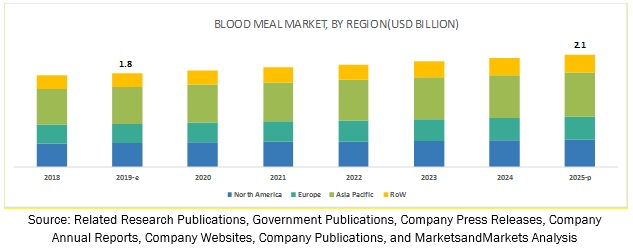
The report "Blood Meal Market by Source (Poultry, Porcine, and Ruminant), Application (Poultry Feed, Porcine Feed, Ruminant Feed, and Aquafeed), Process (Solar Drying, Drum Drying, Ring & Flash Drying, and Spray Drying), and Region - Global Forecast to 2025", The market for blood meal is estimated to be valued at USD 1.8 billion in 2019 and is projected to grow at a CAGR of 3.0% from 2019 to 2025, to reach USD 2.1 billion by 2025. The growing feed industry is one of the major factors driving the growth of the blood meal market, as feed plays a major role in the global food industry. The increasing use of blood meal ensures safe and nutritious feed for animals.
Report Objectives:
By application, the poultry blood segment is projected to dominate the blood meal market during the forecast period
The blood meal market, on the basis of application, is subsegmented into porcine feed, poultry feed, ruminant feed, and aqua feed. The demand for poultry products remains high in emerging countries of the Asia Pacific, resulting in the slaughter of animals. Thus, a large amount of blood is released from animals, creating opportunities for blood meal manufacturers. In addition, the rise in the consumption of poultry products in this region due to the increased demand for protein-rich foods is projected to drive the blood meal market in the coming years.
By source, the poultry blood segment is projected to dominate the blood meal market during the forecast period.
The poultry blood segment is estimated to account for the largest share in the blood meal market in 2019. Poultry blood is the most preferred raw material, which is used to produce blood meal due to its high amino acid content, particularly Lysine. Majority of the key players such as Boyer Valley (US), Valley Proteins Inc. (US), TerraMar Ingredients LLC (Chile), and FASA Group (Brazil) offer blood meal products that are made up of poultry blood meal.
Speak to Analyst: https://www.marketsandmarkets.com/speaktoanalystNew.asp?id=84855008
The expansion of the feed industry due to the rise in population is projected to drive the blood meal market in Asia Pacific
The Asia Pacific blood meal market is driven by the increase in disposable incomes, rise in urbanization, and expansion of the feed industry. The Asia Pacific region witnesses the presence of major revenue generating countries such as China and Vietnam. These countries witness high consumption of meat products such as pork and are ranked among the largest producers of feed at a global level. These factors are projected to drive the blood mal market in the coming years in the region.
Key Market Players:
Key players identified in this market include Darling Ingredients Inc (US), Terramar (Chile), Valley proteins Inc. (US), West Coast Reduction Ltd. (US), and Allana Group (India). These companies have a strong presence in North America and Europe. They also have manufacturing facilities along with strong distribution networks across these regions.
Report Objectives:
- To define, segment, and project the global market size for blood meal
- To understand the structure of the blood meal market by identifying its various subsegments
- To provide detailed information about the key factors influencing the growth of the market (drivers, restraints, opportunities, and industry-specific challenges)
- To analyze the micromarkets, with respect to, individual growth trends, future prospects, and their contribution to the total blood meal market
- To project the size of the market and its submarkets, in terms of value and volume, with respect to the regions (along with their respective key countries)
- To profile key players and comprehensively analyze their core competencies
- To understand the competitive landscape and identify the major growth strategies adopted by players across key regions
- To analyze the competitive developments such as expansions & investments, mergers & acquisitions, new product launches, partnerships, joint ventures, and agreements
By application, the poultry blood segment is projected to dominate the blood meal market during the forecast period
The blood meal market, on the basis of application, is subsegmented into porcine feed, poultry feed, ruminant feed, and aqua feed. The demand for poultry products remains high in emerging countries of the Asia Pacific, resulting in the slaughter of animals. Thus, a large amount of blood is released from animals, creating opportunities for blood meal manufacturers. In addition, the rise in the consumption of poultry products in this region due to the increased demand for protein-rich foods is projected to drive the blood meal market in the coming years.
By source, the poultry blood segment is projected to dominate the blood meal market during the forecast period.
The poultry blood segment is estimated to account for the largest share in the blood meal market in 2019. Poultry blood is the most preferred raw material, which is used to produce blood meal due to its high amino acid content, particularly Lysine. Majority of the key players such as Boyer Valley (US), Valley Proteins Inc. (US), TerraMar Ingredients LLC (Chile), and FASA Group (Brazil) offer blood meal products that are made up of poultry blood meal.
Speak to Analyst: https://www.marketsandmarkets.com/speaktoanalystNew.asp?id=84855008
The expansion of the feed industry due to the rise in population is projected to drive the blood meal market in Asia Pacific
The Asia Pacific blood meal market is driven by the increase in disposable incomes, rise in urbanization, and expansion of the feed industry. The Asia Pacific region witnesses the presence of major revenue generating countries such as China and Vietnam. These countries witness high consumption of meat products such as pork and are ranked among the largest producers of feed at a global level. These factors are projected to drive the blood mal market in the coming years in the region.
Key Market Players:
Key players identified in this market include Darling Ingredients Inc (US), Terramar (Chile), Valley proteins Inc. (US), West Coast Reduction Ltd. (US), and Allana Group (India). These companies have a strong presence in North America and Europe. They also have manufacturing facilities along with strong distribution networks across these regions.

0 comments:
Post a Comment